
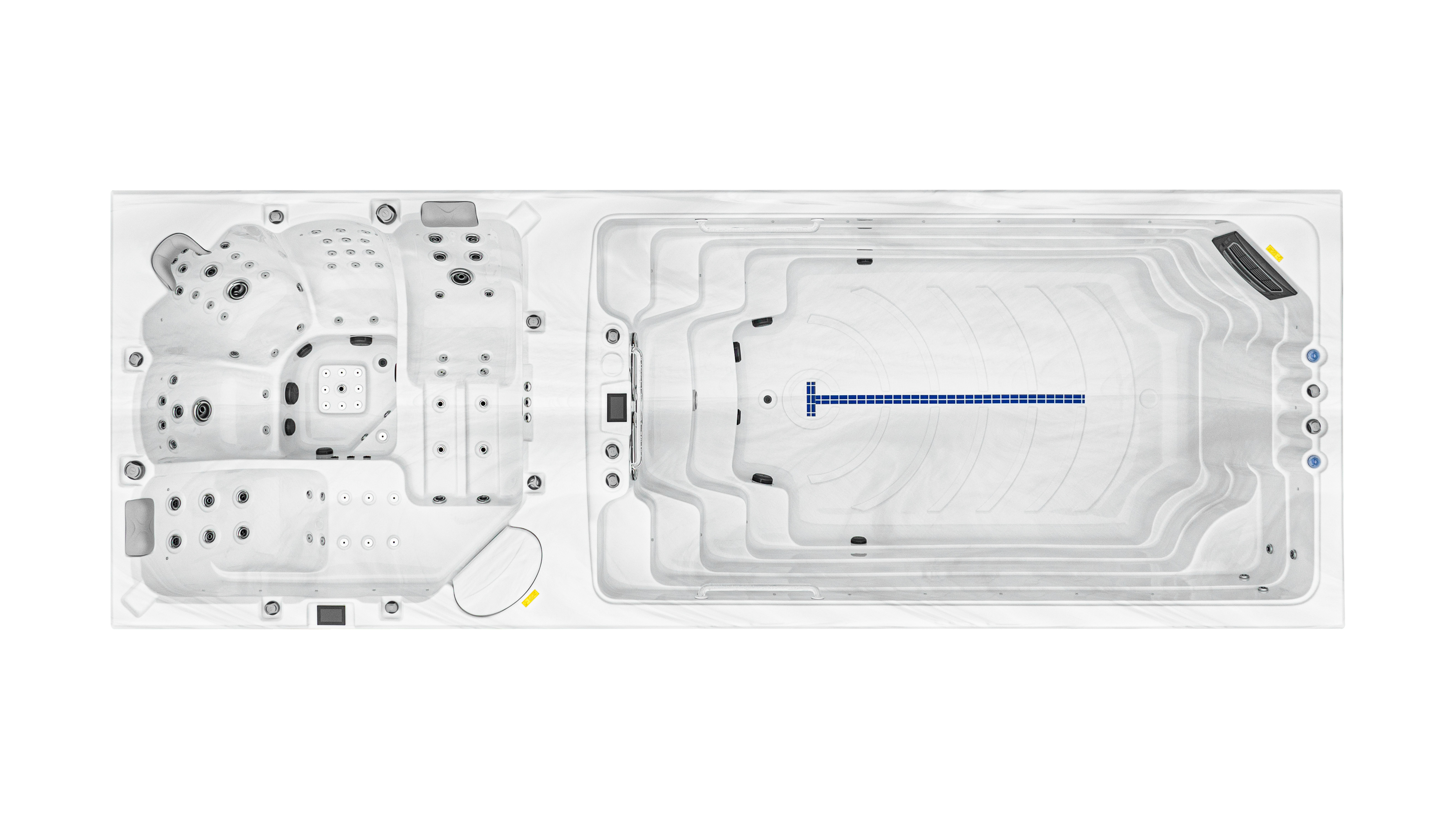
The swim-spa category has moved from niche luxury to mainstream wellness product in less than a decade. Industry analysts now forecast the global market will exceed USD 2.8 billion by 2030, growing at 8% CAGR from 2024. Here is why the momentum is accelerating.
1. The Year-Round Value Proposition
Unlike a conventional swimming pool — which in northern Europe or North America sits idle for six to eight months — a swim spa runs at any temperature year-round. Heated to 30–34 °C in winter it doubles as a hot tub; cooled to 26 °C in summer it is a lap pool. That 12-month usability dramatically improves the return on investment for consumers.
2. Space Efficiency
Average garden sizes in the UK, Germany and France have declined as urban density rises. A full-length swimming pool (typically 8–10 m) simply does not fit most residential plots. Swim spas from 3.8 m to 7.5 m deliver genuine lap-swimming in a fraction of the footprint.
3. The Wellness Mega-Trend
Post-pandemic consumer spending on at-home wellness has surged. Cold plunges, hydrotherapy, and aquatic fitness have all seen double-digit growth on social media and in retail. Swim spas sit at the intersection of all three — exercise, relaxation, and social gathering.
4. Dual-Zone Technology
The introduction of independently controlled swim and spa zones (as featured in models like the SpaRelax 5U70, 7U40 and 6U20) has expanded the addressable market: one product serves both the serious swimmer and the family hot-tub user simultaneously.
Takeaway for Dealers
Consumers are increasingly arriving at dealerships having already researched online — they know the jet counts, dimensions, and amp requirements. Dealers who can demonstrate in-water and offer finance options convert at significantly higher rates. The swim-spa segment rewards investment in showroom space and staff training.